Opto-Mechanical Urine Microscopy
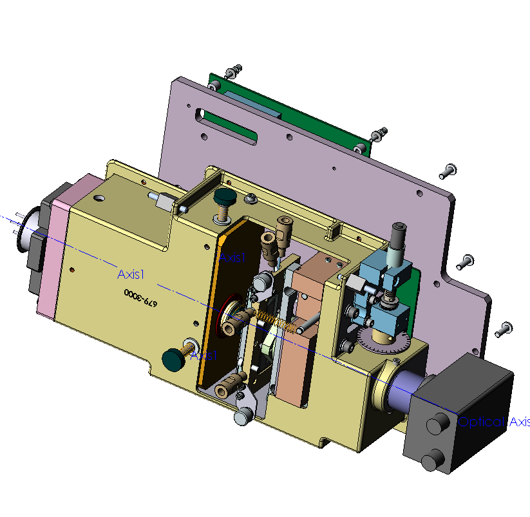
This project involved the design of a mechanism for an opto-mechanical module and flow cell requiring precise motion control, high repeatability, and mechanical stability without friction or backlash. The design was developed to support optical systems where micron-level positioning accuracy and long-term reliability are critical. The optical bench is part of a automated urine microscopy instrument that identifies and differentiate particle in urine for medical analysis.
Engineering Scope:
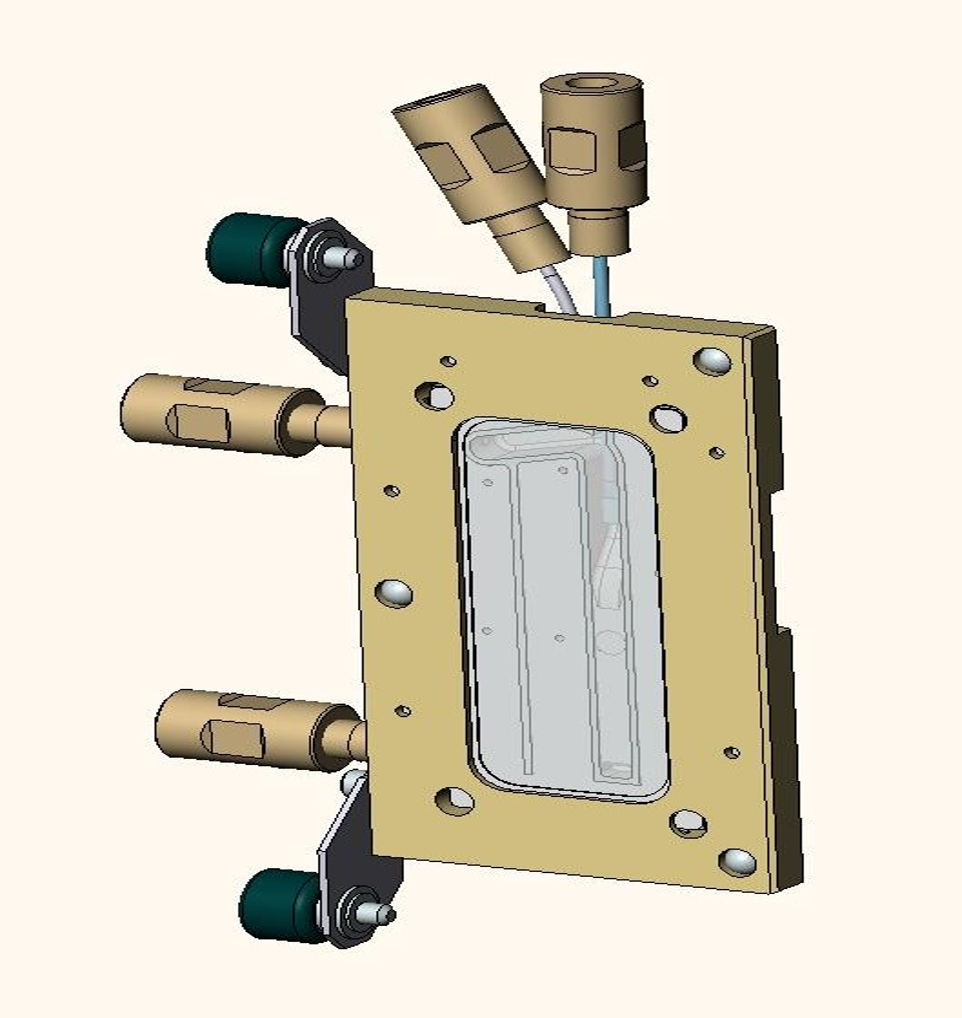
Provide a protective holder for the flow cell that can be positioned accurately in the optical bench.
Provide means for aligning the lamina of particles in the flow cell to be coincident with the focal plane of the objective lens.
Provide for computer control of focus position within less than one micron.
Optical bench is to be sturdy and long-lived.
Optical bench is to be easy to adjust and service.
Key Design Considerations:
Elimination of friction and backlash through flexure mechanisms design
Controlled precise objective micro positing motion control
Mechanical stability for optical alignment
Sensitivity to manufacturing tolerances
Means of achieving requirements
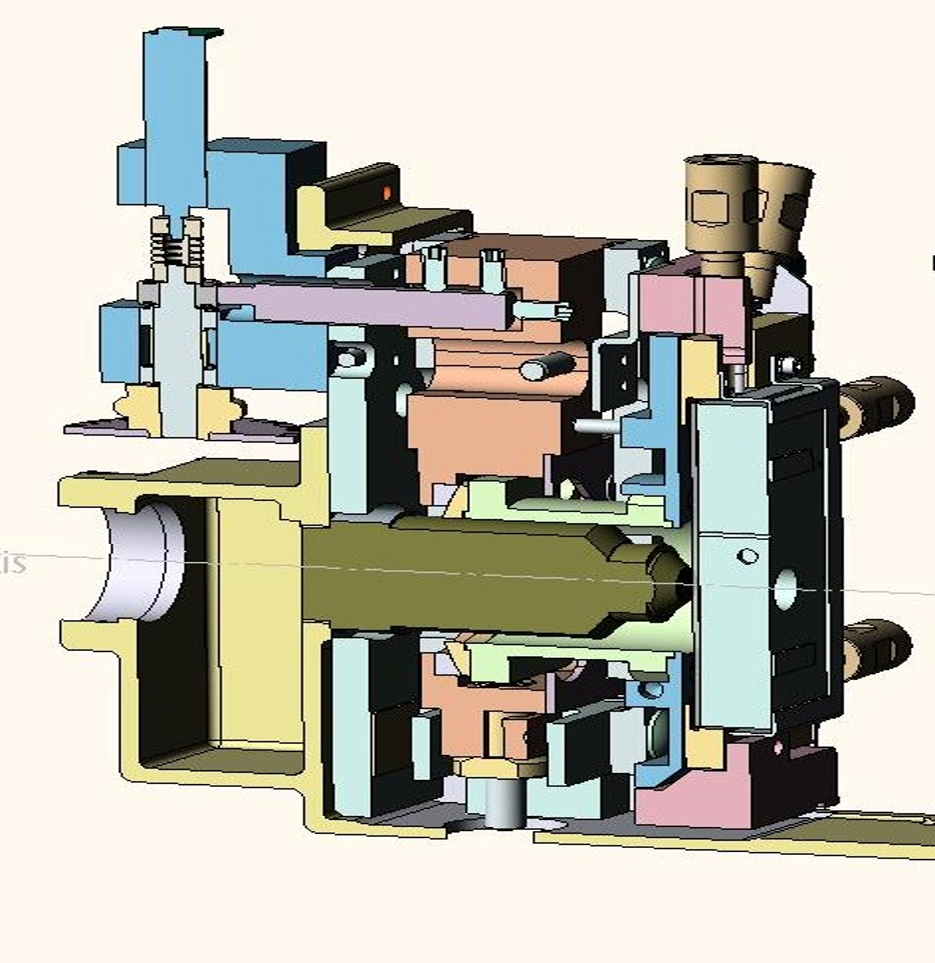
The flexure parallelogram movement is free of stiction and the changes in performance found in ball slides when making repeated small moves.
Both the stage and the objective lens are mounted on the same surface of the optical bench enclosure.
The anti-friction bearing eccentric drive avoids the wear and friction problems typical of screw type actuators.
Adjustment of the stage is provided by a spherical bearing with its center at the focal plane.
Fine pitch actuators permit independent adjustment of horizontal and vertical tilt without significant change in focus.
Aluminum Cast housing for proper refence establishment.